
by David Jin
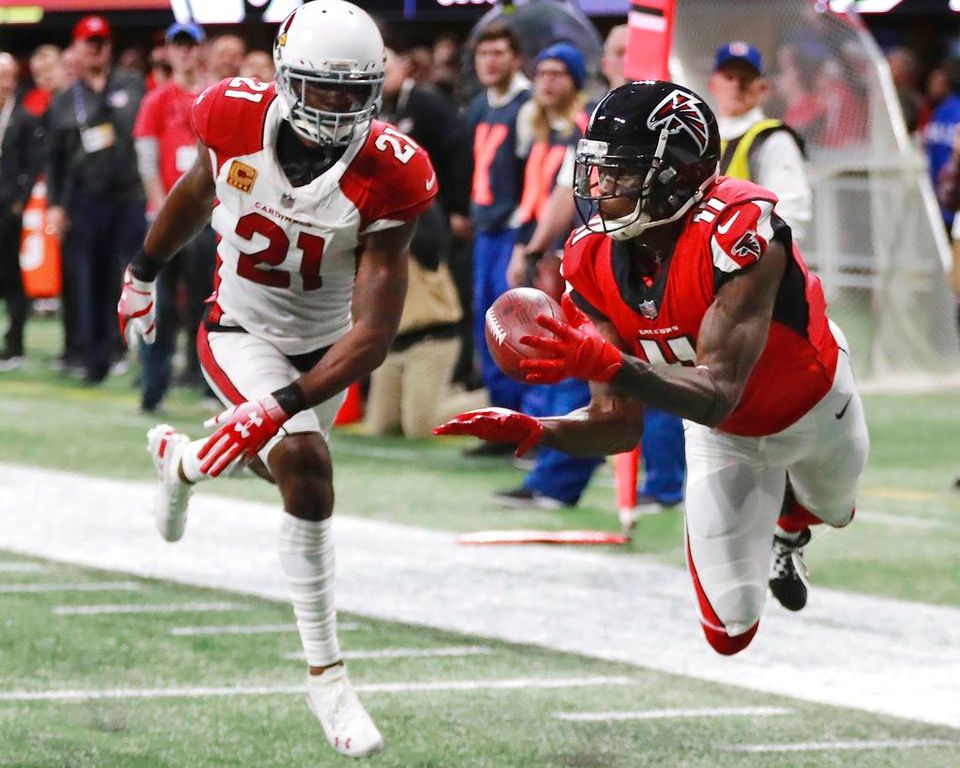
The reactions were swift. “Julio Jones touchdown and our long national nightmare is over,” tweeted The Falcoholic. On the field, his teammates jumped all over him. It was Week 9 of the 2018 NFL season, November 4th, and Julio Jones, would once again lead the league in receiving yards, had finally scored a receiving touchdown.
This reaction is indicative of the accusation that has dogged Jones over the years. He is guilty of the crime of racking up tons of yards, but being unable to reach the endzone, which is where the game is won. Even beyond the usual fan gossip, pundits and analysts have all decried this aspect of his game. “Why Does Julio Jones Have So Much Trouble Scoring Touchdowns?” blares the headline of an article by Doug Farrar of Bleacher Report. “Why Can’t Julio Jones Score a Touchdown?” asks Danny Heifetz of The Ringer. Heifetz attributes the inability of Jones to score on the fact that he is either double-teamed in the endzone or that Matt Ryan is incompetent. Farrar echoes the idea that Jones is being used as a dangerous decoy, but also notes that it is on the coaches for wasting his talents in that role. However, there is more to such a result than meets the eye. In this series of articles, I will discuss the furor over Jones’s play, and how his statistics are an interesting combination which are a unique use of his talents by the Atlanta Falcons.
I believe the discussion of efficiency should not boil down to a yards per touchdown deal. Such a way of thinking overlooks many aspects of the game of football. Let us take an extreme example. Suppose a player catches the ball at their own 1-yard line, and takes it 98 yard without scoring. Consider another extreme scenario in which downs do not exist, where a player keeps catching the ball for one yard receptions, taking 98 receptions to get to the opponent’s 1-yard line. In an analysis of using yards per touchdown, these two outcomes would contribute equally to the number of yards it takes for the player to score. However, we can all agree that in most cases, the latter is worse than the former. The latter would require running 98 full plays in which the play is called (audible or by a coordinator), players line up, run routes, get tackled, wash, rinse, repeat. This is truly inefficient football only meant for the specific scenario of burning clock.
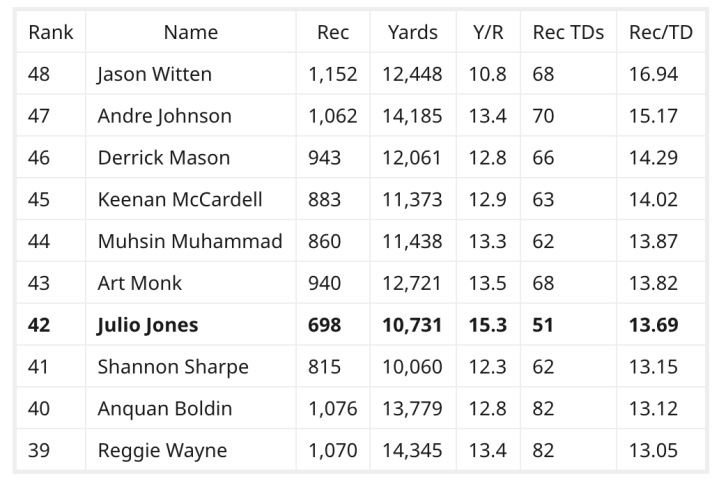
The upshot of this is that the discussion of efficiency should revolve around receptions per touchdown, not yards. Each reception is a chance for a player to make efficiency happen. Below I have listed, among players with at least 10,000 receiving yards, the worst ten players in terms of how many receptions it took to get a touchdown. Perhaps unsurprisingly, Jones ranks near the bottom of the metric, but his company may surprise you:
To put it in perspective, this is the distribution of players’ receptions per touchdown:
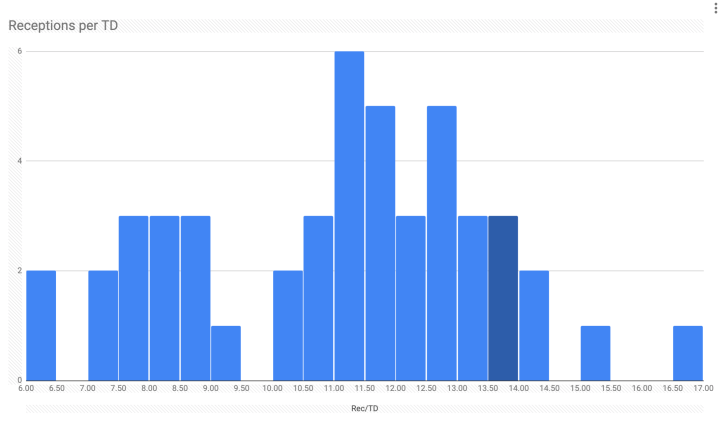
Jones’s three-person bin, consisting of him, 14-year veteran Muhsin Muhammad, and Hall of Famer Art Monk, is highlighted. Immediately, Jones’s statistics among the worst ten players of this metric jump out. Firstly, he has by far the fewest number of touchdowns, of them all, but, by corollary, has the fewest number of receptions and highest yards per reception among them. Given the number of times he has the ball, he has reached the end zone at the same rate as other players.
Keeping in mind the interpretation of taking advantage of receiving opportunities, I am very disappointed that I could not perform another analysis, touchdowns per target. This data was not available prior to 1992 (dangit, Pro Football Reference), and would therefore omit data from legends such as Jerry Rice, Tim Brown, and James Lofton. In addition, this metric, more than receptions per touchdown, depends upon the ability of the quarterback to execute the target, taking us away from considering the receiver’s abilities.
I highly doubt that anybody would accuse Reggie Wayne or Shannon Sharpe of being poor scorers. And yet, the amount of receptions it took per touchdown in their cases is just about as many as it took for Jones to get his. As Jones nears the reception numbers put up by these Hall of Fame receivers, it will be interesting to see how his touchdown count shapes up.
Moreover, who is to say that usage of Jones as a powerful goal line decoy any more or less a waste of talent as having him catch touchdowns? His mere presence has helped players like Mohamed Sanu, More importantly, though, as Jones moves into the latter half of his career, it will be interesting to see if he can keep up the record setting pace that has helped take the Falcons to the Super Bowl once before.
tl;dr An abridged version of this post can be found here.
Many thanks as always to Pro Football Reference for the statistics used in this article.
 HEX Sports
One thought on “The Enigma of Julio Jones, Part I”