
by David Jin
The multi-talented running backs of the NFL are the talk of the town, and one discussion centers on whether we should even call them RBs. Players like Alvin Kamara and Le’Veon Bell are receiving and rushing threats, confusing opposing defenses and being true offensive weapons, capable of contributing at nearly all the facets of an offense. It seems that in the modern NFL, an RB who is not a reliable pass receiver have been viewed as old-school, dated; take, for example, Adrian Peterson’s disastrous 2017 season in which he had 27 carries for 81 rushing yards and two receptions for four yards with the Saints. He fit so little into the Saints’ formidable passing attack that he was near immediately traded to the Arizona Cardinals. His departure opened the way for a new offensive weapon: Alvin Kamara.

When did this metamorphosis from a smashmouth back to a multi-talented running back happen? Many have attributed it to the passer-friendly rules of the NFL, or the infiltration of college football’s positionless offensive schemes. However, the history of multi-talented backs begins way before the 2000s, in fact, even before the Super Bowl era. Backs like George McAfee (1940-41, 1945-1950) and Willie Galimore (1957-1963) were superb receivers as well as runners, whose dangerous abilities caused as many headaches for their peers of the past as the versatile running backs today. For our analysis, however, we will focus on the Super Bowl era.


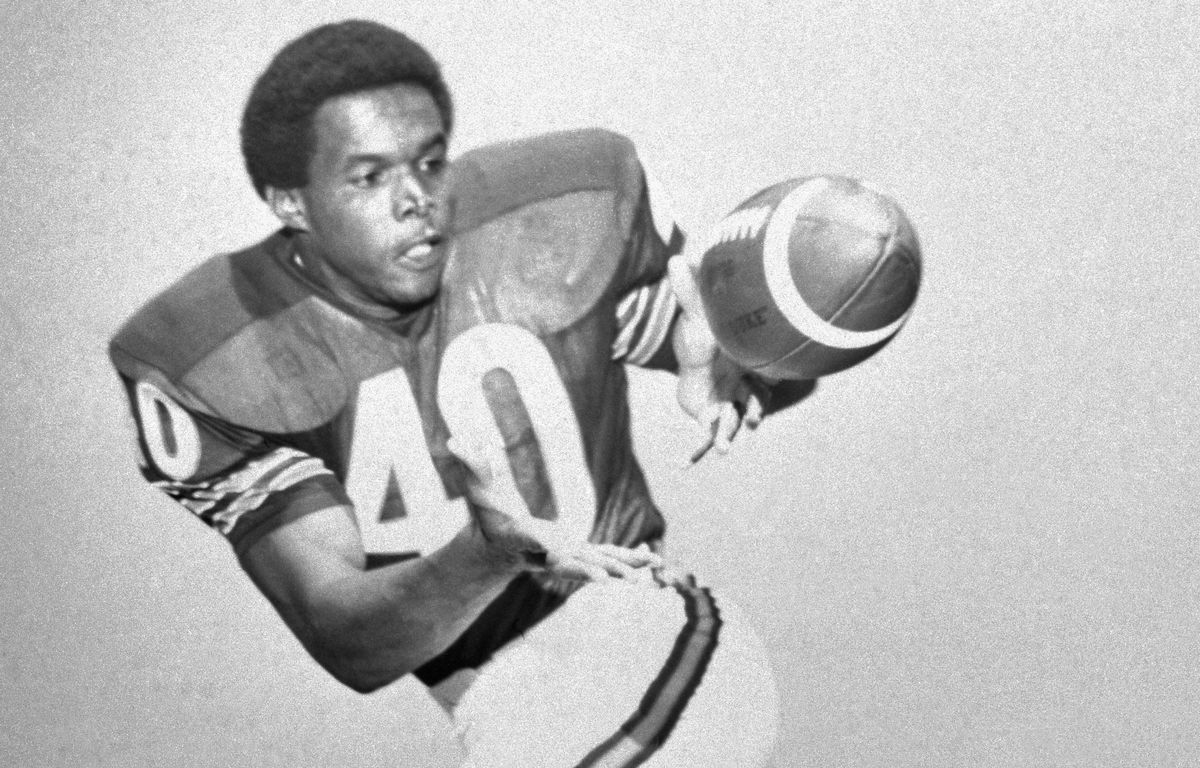
Before we take a look at recent seasons, we need to start from the beginning of the Super Bowl era. The first great versatile running back of the Super Bowl era was the Kansas Comet, Gale Sayers. His 1966 season, which still ranks 12th all-time in all-purpose yards, included 1,231 rushing yards, 447 receiving yards, 44 punt return yards, and 718 kick return yards. These came with 8 rushing touchdowns, 2 receiving touchdowns, and 2 kick return touchdowns. As we know, Sayers’s career was cut short by injury, and it is interesting to consider what he might have been able to contribute in redefining the running back position. Would his speed have made pass plays more designed for him? Or would he have become an elite checkdown option in the absence of an open receiver downfield? That question is left to history.
Fast forward to 1985, and the innovations of the intervening years began to blossom. Most notably, the state of California brought two of the most dominant offensive schemes of all time, Air Coryell of the San Diego Chargers, and the West Coast Offense of the San Francisco 49ers. Air Coryell, the product of Don Coryell, made the deep option the first read, and running backs were not spared from this philosophy either, with Chargers’ running back Lionel James putting up 1,027 receiving yards on 86 receptions. James’s statistics included 516 rushing yards, 213 punt return yards, and 779 kick return yards, setting a record for all-purpose yards at 2,535. His 1985 total remains the 4th most single season all purpose yards in league history.


Further up the coast, the San Francisco 49ers were cooking up the West Coast offense for which Joe Montana and Steve Young would be immortalized. However, their running backs should also be remembered for their contribution to the legends of the 49ers. In Bill Walsh’s West Coast offense, instead of trying to bash the offense against a brick wall, short passes were used to get around them. This meant that running backs were integral receivers, for which running back Roger Craig readily stepped up to the plate. In 1985, Craig became the first player to have 1,000 yards rushing and receiving, with 1,050 rushing yards and 1,016 receiving yards. Both Air Coryell and the West Coast offense would foreshadow the offensive schemes of the modern NFL, including their use of running backs.
The 1990s brought a new offensive scheme, the K-Gun, run by quarterback Jim Kelly and the Buffalo Bills (yes, those Bills that lost four in a row). This was a no-huddle offense with Kelly as the field general, and featured Hall-of-Fame running back Thurman Thomas in both a rushing and receiving role. His first five seasons, he averaged over 10 yards per attempt, an average rarely achieved by running backs, whose pre-snap positions within formations are usually far behind the line of scrimmage.


The West Coast offense was still alive and well, and running back Ricky Watters continued to rack up both rushing and receiving yards, gaining 877 rushing yards and 719 receiving yards in 1994 for the 49ers. In the late ‘90s, Air Coryell also saw its revival in the “Greatest Show on Turf”, the record-setting offense of the St. Louis Rams’ offensive coordinator Mike Martz. In 1998, among the 6,412 yards of total offense, running back Marshall Faulk gained 1,381 rushing yards and 1,048 receiving yards, becoming the second player after Craig to have 1,000 yards rushing and receiving in a single season.
Amongst this backdrop arose running back (and wide receiver and legendary return specialist) Eric Metcalf, who at various times in his career gained 633 rushing yards, 1,189 receiving yards, 489 punt return yards, and 1,218 kickoff return yards in a single season. He also held the record for punt return touchdowns (10) until it was broken by Devin Hester (14). Indeed, it almost seemed as if his teams didn’t know what to do with him, with the Cleveland Browns giving him a more balanced workload as a running back and receiver, the Atlanta Falcons giving him a greater receiving role, and spending his final five seasons with five different teams who all used him almost exclusively as a returner, but with varying kickoff return duties (he remained a punt returner until the end of his career).


As useful as all these players from the preceding thirty years of the Super Bowl era were as receivers, they were the exception, not the rule. Players like Barry Sanders (max 480 receiving yards in a single season), Tony Dorsett (459), O.J. Simpson (426), Emmitt Smith (414), Eric Dickerson (404), Terrell Davis (367), John Riggins (363), and Franco Harris (291) and all had receiving as a secondary duty. Though they caught passes, their role on the team was not defined by their usage as a receiver without which their scheme could not be complete.
Still, the 2000s and early 2010s produced several well-rounded running backs amongst the many one-dimensional ones. Much maligned New Orleans Saints running back Reggie Bush was a consistent tool in the arsenal of Drew Brees, with whom he set the NFL record for most receptions by a rookie player. He would also go on to return 4 punts for touchdowns with the Saints. His later years would see him showcase his abilities as a traditional three-down back, with a 1,000 rushing yard season for both the Miami Dolphins and Detroit Lions. Matt Forte, the current record holder receptions by a running back in a season, actually led the Chicago Bears in receptions during his rookie season. During the five seasons in which he played all 16 games, he never had fewer than 51 receptions nor 471 receiving yards.


And just as we began with discussing their personnel, we shall conclude with the New Orleans Saints. In 2011, running back Darren Sproles earned the single-season record for all-purpose yards, with 2,696. He earned 603 yards rushing, 710 yards receiving, 294 yards on punt returns, and 1,089 yards on kick returns. His career, unlike Metcalf’s has truly maintained a consistent balance. He has never had more than a 48-touch difference between rushing attempts and receptions, and has averaged a 22.7 offensive touch difference per season in his career (excluding his 2006 season when he was out for the season after breaking his ankle, and his 2017 season in which he was placed on injured reserve after 3 games). His versatility has allowed him to gain 30 receiving touchdowns, 22 rushing touchdowns, 7 punt return touchdowns, and 2 kickoff return touchdowns. His balanced offensive capabilities, and his return skills make him arguably the most balanced player of all time.


While it is only of late that a pass-catching running back is the rule in NFL offenses, it is important to understand their history. Even during the preceding half-century when pass-catching running backs have been the exception, there have still been a number of dominant pass-heavy offenses that have used them as integral receivers within their gameplan. Although the schemes of the mid-to-late 2010s have been labeled novel, their fundamentals have long existed.
 HEX Sports